If you’re dreaming about the most beautiful towns in France, not just to visit but to truly experience, you’re in the right place.

Table of Contents
Which are the Most Beautiful Towns in France?
The real question isn’t only which towns are beautiful. It’s which ones might feel like home to you. (Something I explore more deeply in my guide to living in France by lifestyle).
Over the past three years I’ve been slowly exploring France, often far from the big cities. Along the way I started noticing something interesting. The towns people fall in love with aren’t always the ones in the glossy brochures. They’re the ones that feel lived-in, layered and quietly authentic.
That’s what I’m looking for when I explore towns in France. Not perfection, but feeling.
A café that’s been open longer than your country has existed. Nothing scrubbed too clean. A sense that life has been unfolding here for centuries.
Weathered stone. Uneven steps. Moss on old walls. Shutters with paint gently peeling in the sun. These aren’t flaws. They’re what give a place soul.


And in a truly beautiful town in France, the town and the landscape seem to talk to each other. Streets are walkable and human in scale. Everyday life still happens.
Markets still run. Locals still argue over coffee. Laundry is hung out. Church clocks mark time.
For some people, a beautiful town might be the perfect place to spend a week experiencing real life. For others, it’s the kind of place that sparks a bigger question…
Could I actually live here?
That’s the spirit behind this guide. Not just finding the most beautiful towns in France, but discovering which ones might fit the life you’re dreaming about, whether that’s a retirement escape, a second home, a slow-travel base, or simply a place that keeps calling you back.
BTW Could I actually live here? is the same question I explored when I spent time considering what living in Perigueux might really feel like day to day among other towns.

How do you find the most beautiful town for you?
I find choosing among the many beautiful towns in France isn’t about ranking places from best to worst.
It’s about recognising which places feel like you.
When you choose by vibe, not checklist, the experience changes completely.
I’ve narrowed it down to four distinct vibes, each paired with towns that I find embody that feeling.
As you read, notice which description makes you exhale a little.
That’s your town vibe.
Click on the names that speak to you to read more.
Coastal Charm, Salt and Sun

You’re drawn to places where the air smells faintly of salt and the sound of surf follows you all day. You love long walks, early mornings, and watching the light shift across the water.
You’ll feel most at home if you love:
- Long walks along the sea
- Simple seafood lunches surrounded by relaxed vacationers
- A bustling centre during the day that feels calm once day‑trippers leave
- Evenings that are quiet rather than happening
This vibe suits you if you don’t need nightlife to feel alive.
You’re happy with a book, a glass of something cold, and the sound of water somewhere nearby.
Honfleur, Calvados, Normandy
A painterly harbour and former fishing port, known for reflective light and a hushed, romantic feel once the tour buses leave.
Arcachon, Gironde, Nouvelle-Aquitaine
Belle Époque refinement meets Atlantic air. Pine forests, oyster culture, and a slower coastal rhythm shape daily life here.
Soulac-sur-Mer, Gironde, Nouvelle-Aquitaine
A seaside town shaped by its past, with vacation homes built mostly between 1890 and 1920. Long sandy beaches, wide skies, and a quietly nostalgic charm define its rhythm.
Artist’s Dream

You notice textures, light, and small details.
You’re happy wandering with no plan, popping into galleries, and lingering over coffee while sketching or journaling.
You’ll love towns that offer:
- A creative undercurrent without feeling pretentious
- A mix of beauty and lived‑in imperfection
- Slow mornings, charming architecture, and a sense of slow living
- Enough life to feel inspiring, not overwhelming
This vibe suits you if you travel to feel something and reflect, not to see everything.
Uzès, Gard, Occitanie
Elegant, lived‑in, and creative. The town has many small art galleries and workshops, and it rewards staying put and settling into local routines.
Ségur‑le‑Château, Corrèze, Nouvelle-Aquitaine
Quiet, authentic, and almost untouched. Ideal for travellers who crave silence and simplicity, with mischievous little clay statues tucked throughout the village.
Monpazier, Dordogne, Nouvelle-Aquitaine
Geometric calm, an arcaded square, and a soothing sense of order. The town has become a dedicated centre for the arts, with many artists working and selling directly in the village.
Étretat, Seine-Maritime, Normandy
Dramatic cliffs by day, but surprisingly quiet and contemplative in the early mornings and evenings. Its charm even attracted painters like Claude Monet.
Medieval Drama, Built on a Cliff

You’re moved by places that feel theatrical and timeless.
You love winding streets, stone walls, and views that stop you mid‑step.
You’ll feel at home in towns that have:
- A strong sense of history and setting
- Elevation, drama, and views
- Mellow evenings that feel almost cinematic
- A feeling of being “held” by the landscape
This vibe suits you if you like places that feel powerful and a little awe‑inducing, even when they’re quiet.
Mont‑Saint‑Michel, Manche, Normandy
A UNESCO World Heritage site featuring an 8th-century abbey and a fortified village perched on a rocky tidal island. Iconic, yes, but staying overnight reveals a haunting, reverent stillness most visitors never experience.
Rocamadour, Lot, Occitanie
Spiritual, vertical, and deeply dramatic, a place that feels suspended in time and space. Especially when viewed from above in a hot air balloon at dawn!
Monflanquin, Lot-et-Garonne, Nouvelle-Aquitaine
Elevated and quietly busy without ever feeling overwhelmingly busy like Mont‑Saint‑Michel can be during peak tourist season. It’s a perfectly preserved 13th-century bastide town with grid streets and an arched centre plaza with exceptional panoramic views.
Storybook Villages

You’re charmed by ancient houses, flower boxes, and streets that feel like they belong in an illustrated book, or a movie.
You’ll enjoy towns that offer:
- A scale meant for humans, not cars
- A gentle pace and a clear daily rhythm
- Small pleasures, bakeries, church bells, and market mornings
- Beauty that feels intimate
This vibe suits you if you want to live somewhere straight out of a whimsical movie like Chocolat.
Riquewihr, Alsace, Grand Est
Perfectly preserved, charming, and surprisingly peaceful once evening arrives. Surrounded by vineyards and known for its colourful 16th‑century half‑timbered houses and cobblestone streets. Rumoured to have inspired Disney’s Beauty and the Beast.
Beuvron‑en‑Auge, Calvados,Normandy
Half‑timbered houses with slate roofs, overflowing flower boxes, and a slower countryside rhythm. Horses, cows, quaint shops, and local producers all contribute to its Normandy charm.
Flavigny‑sur‑Ozerain, Côte-d’Or, Burgundy
Contemplative and deeply rooted, the kind of place where time softens. Surrounded by ancient ramparts and criss‑crossed by narrow cobblestone streets. Renowned as the filming location for Chocolat.
More Detailed Descriptions of these French Villages


Intrigued about these most beautiful towns in France? Then read on for more details.
To keep things consistent and easy to compare, each town below is explored using the same town card format.
This isn’t about ticking boxes. It’s about giving you the kind of practical, lived-in details that help you decide where you’d actually enjoy staying.
Each town card includes:
- Crowd honesty – what crowds are really like, and how that changes by season
- Average weather by season – so expectations match reality
- Don’t-miss slow moment – one small experience that captures the town’s rhythm
- Market day – because markets reveal everyday life
- Car-free or car-needed – what’s realistic once you arrive
- Elske’s tips – the details that don’t fit neatly anywhere else, but matter

Think of these as stay vibes, not sightseeing summaries. I’ve also grouped the towns by region and nearest commercial airport so that it can make your planning easier.
You can also find a map at the end of the post with all the towns pinned.
Normandy Towns
Fly into Paris

Normandy is often the first region travelers explore beyond Paris, and for good reason.
It’s close enough to feel easy, yet different enough to feel like a true shift in pace.
These towns combine coastline, history, and lived‑in charm, especially rewarding if you’re willing to stay longer.
Honfleur, Calvados, Normandy

Vibe: Coastal Charm, Salt and Sun
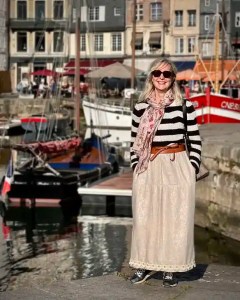
Honfleur is one of the prettiest port villages I’ve ever seen. Slate-covered houses line the harbour, their reflections constantly shifting with the light at the mouth of the Seine.
It may be popular, but it never feels hollow. Harbour front restaurants are welcoming and relaxed, while quieter streets nearby offer excellent food and a slower pace.
What stays with me is how lived-in it feels. Compact, walk-able, and endlessly photogenic, Honfleur is a town where light and everyday life quietly steal the show.
Crowd honesty
Honfleur is very busy from late morning (it’s noticeable when the tour buses arrive) through mid‑afternoon, especially from May to September.
Once tour buses leave, usually after 5 pm, the town softens considerably.
Spring and autumn are ideal for balance. With warm days still possible right into October.
July and August are lively, which you might enjoy, but still manageable if you plan mornings and evenings well if you don’t.
Average weather by season
- Spring: Cool to mild, with shifting light and occasional rain
- Summer: Mild and breezy, rarely extreme heat
- Autumn: Crisp mornings, golden light, fewer crowds
- Winter: Quiet, grey, atmospheric, and often beautifully still
Don’t‑miss slow moment
Walk to the lavoir, where the local washerwomen still regularly washed clothes right up to the 1980s! Today some residents still go there to draw water for their gardens.
Market day
Saturday mornings in the Place Sainte-Catherine: best visited early while locals still outnumber visitors.
Car‑free or car‑needed
Car‑free is easy within Honfleur itself.
A car is a must if you want to explore the surrounding Normandy countryside or coast.
Elske’s tips

Head up to Mont Joli just outside the town and get a beautiful panoramic view of the town and the Pont de Normandie bridge in the distance. You can hike up a zig zagging trail to get there or drive up in a round about scenic route which is less physically taxing.
Étretat, Seine-Maritime, Normandy

Vibe: Artist’s Dream
Étretat has that kind of fictional, dramatic charm, the sort of place where you half expect a sharp-eyed detective from a classic French novel, or perhaps Arsène Lupin, the gentleman burglar, to come around the corner. Maurice Leblanc, who wrote the famous books, the inspiration for the Netflix series Lupin, lived in Étretat.
The town itself is small and walkable, tucked between chalk cliffs and open sea. Even though it’s touristy, it still has a salt-of-the-earth feel. It hasn’t lost its authentic fishing-port charm. There are absolutely stunning hikes along the clifftops. Light, mist, and waves do most of the talking here.
Crowd honesty
Étretat is very busy from late morning to mid‑afternoon, especially from May through September. As in, don’t even try to get your car in or out of the town during that time.
Early mornings and evenings are dramatically quieter, even in high season.
Spring and autumn offer the best balance of atmosphere and space.
Average weather by season
- Spring: Cool, windy at times, with fast‑changing skies
- Summer: Mild temperatures, frequent breezes, occasional fog
- Autumn: Moody light, fewer visitors, crisp air
- Winter: Raw, dramatic, and very quiet, best for contemplative stays
Don’t‑miss slow moment
Walk the clifftop path just after sunrise, when the arches emerge through mist and the town is still asleep. It’s a great place to do some Uitwaaien.
Market day
Thursday mornings at Place du Maréchal Foch, modest in size but rooted in local products.
Car‑free or car‑needed
Étretat is manageable without a car once you arrive.
A car is helpful if pairing Étretat with other Normandy coastal towns or countryside stays.
Elske’s tips

View the Porte d’Aval from the other side, a less common perspective that requires a bit of effort. See how we did it here.
Stay at least one night. Étretat’s true personality appears outside peak hours.
Beuvron‑en‑Auge, Calvados, Normandy

Vibe: Storybook Village
Beuvron‑en‑Auge’s meticulously preserved 16th‑ to 18th‑century half‑timbered houses, slate roofs, and generous flower boxes create a sense of quiet order that feels deeply calming.
This is the kind of place where nothing is rushed. Life moves at a rural rhythm, shaped by seasons, markets, and conversations that linger longer than planned. It’s the quintessential charming rural small town.
Despite its small size, the village is a hub for local culture and crafts. You’ll find numerous arts and crafts studios, antique shops, and galleries in the market square and the old schoolhouse.
Crowd honesty
Beuvron‑en‑Auge is never truly crowded.
Late spring through summer brings more visitors during the day, especially on weekends, but it rarely feels busy, just somewhat animated. Even when the tour buses arrive it still doesn’t feel overwhelming.
Early mornings and evenings remain calm year‑round. Autumn is especially lovely and very quiet. Some shops close mid‑week in the winter.
Average weather by season
- Spring: Mild, green, and fresh, with occasional rain
- Summer: Warm days, cooler evenings, very comfortable
- Autumn: Crisp air, golden light, and fewer visitors
- Winter: Quiet and atmospheric, bring your woolies!
Don’t‑miss slow moment
Sit in the village square mid‑morning with a coffee and simply watch daily life unfold. It’s surprisingly meditative.
Market day
Saturday mornings, under its historic, 18th-century covered market hall, small but excellent, with local producers and regional specialties.
Car‑free or car‑needed
Beuvron‑en‑Auge sits firmly in the countryside, and public transport options are very limited. Once there, everything is walkable.
A car is essential.
Elske’s tips

Visit the on farm store right beside the church for local cider and cheese.
This is a wonderful base if you want to experience rural Normandy without isolation.
Mont‑Saint‑Michel, Manche, Normandy

Vibe: Medieval Drama, Built on a Cliff
Mont‑Saint‑Michel, with its 8th‑century abbey rising above a fortified village on a rocky tidal island, feels otherworldly. Medieval drama at its peak.
This is not just one of the most beautiful places in France, it’s one of the most emotionally charged places to stay, if you time it right.
Seen during the day, it can feel hectic and overwhelming. Seen up close overnight, it regains a peaceful, almost sacred atmosphere.
Crowd honesty
Mont‑Saint‑Michel is extremely crowded during the day, except for November through February.
Between roughly 10 am and 5 pm, crowds are dense, especially from May through September. Expect slow movement through streets and long waits to enter the abbey.
Early mornings, evenings, and overnight stays are transformative. Once day‑trippers leave, the village empties and the atmosphere shifts completely.
Winter is the quietest season, though weather can be dramatic.
Average weather by season
- Spring: Cool, windy, and changeable, with dramatic skies
- Summer: Mild to warm, often breezy, but busy
- Autumn: Cooler air, fewer visitors, beautiful light
- Winter: Cold, windswept, and very quiet, haunting in the best way
Don’t‑miss slow moment
Step outside just after dusk, once the gates have closed, and walk the ramparts in near silence.
Hearing your footsteps echo on stone is unforgettable.
Market day
There is no traditional market.
For a local market experience, pair your stay with nearby mainland towns such as Pontorson or Avranches.
Car‑free or car‑needed
Private cars are not allowed on Mont‑Saint‑Michel. Parking is in designated lots approximately 2.5 km away, followed by a shuttle or walk across the causeway.
You can also arrive by train to Pontorson, then take the dedicated shuttle.
A car is helpful only if you plan to explore more of rural Normandy afterward.
Elske’s tips
To be honest, if possible, avoid peak summer. The crowds can be overwhelming when you are getting jostled about.

If tides align, plan your visit around them and consider a guided walk across the mudflats. It adds an entirely different dimension to the experience.
Nouvelle-Aquitaine Towns, Atlantic Coast and Dordogne
Fly into Bordeaux Airport

Nouvelle-Aquitaine feels like several regions woven into one generous landscape.
That contrast is what makes it so compelling.
Along the Atlantic coast, life moves with tides, wind, and wide open skies.
Inland, the Dordogne unfolds slowly through medieval villages and honey-coloured stone towns.
Bordeaux serves as a natural gateway, making this region surprisingly accessible while still feeling deeply rooted in everyday French life.
Arcachon, Gironde, Nouvelle-Aquitaine

Vibe: Coastal Charm, Salt and Sun
Just west of Bordeaux, Arcachon feels refined without being stiff. Belle Époque villas line leafy streets, and the scent of pine mixes with salt air drifting in from the bay. This is where the wealthy from Bordeaux used to come to get away from the city and “take the air”.
Life here revolves around the water. Oyster huts, promenades, and changing tides shape the daily rhythm, giving the town an easy-going Atlantic pace.
Crowd honesty
Arcachon is lively from late spring through summer, especially in July and August.
Day‑trippers arrive midday, but the town still feels spread out rather than compressed.
Early mornings and evenings are calmer, particularly outside peak season and weekends.
Average weather by season
- Spring: Mild and fresh, with sunny days and cool evenings
- Summer: Warm but moderated by sea breezes
- Autumn: Soft light, fewer visitors, pleasant temperatures
- Winter: Cool, quiet, and atmospheric and the bay protects from the worst Atlantic winds
Don’t‑miss slow moment
Enjoy oysters at a harbour hut in the late afternoon, when locals linger and the bay settles.
Market day
Daily morning covered market near the town centre at the Place des Marquises.
Car‑free or car‑needed
Car‑free works well within Arcachon itself.
A car is useful for exploring the wider bay and nearby villages.
Elske’s tips
Visit the Dune du Pilat, the tallest sand dune in Europe. It is magnificent to behold and climb. There is a dedicated shuttle that runs from Arcachon regularly.

Soulac‑sur‑Mer, Gironde, Nouvelle-Aquitaine

Vibe: Coastal Charm, Salt and Sun
North of Bordeaux in the Médoc wine region you find Soulac‑sur‑Mer. It feels very nostalgic and quietly personal.
Its late‑19th‑ and early‑20th‑century holiday villas give the town a gentle, old‑fashioned seaside atmosphere that hasn’t been overly polished. It’s an easy going town with a small centre featuring restaurants, ice cream shops and beachwear stores.
Crowd honesty
Soulac‑sur‑Mer is busiest in July and August, though it rarely feels overwhelming.
Outside peak summer, the town is calm and spacious.
Shoulder seasons offer long walks and wide, empty beaches. So beautiful.
Average weather by season
- Spring: Cool to mild, often breezy
- Summer: Warm days, refreshing ocean winds
- Autumn: Mild, quiet, and ideal for long walks
- Winter: Windy, sparse, and contemplative
Don’t‑miss slow moment
Walk the beach at low tide, when the shoreline feels endless and meditative.
Market day
Daily (except Mondays, Nov-March) in the Marché Couvert found in the heart of the old village.
Car‑free or car‑needed
A car is recommended.
Public transport exists but limits flexibility along the coast.
Elske’s tips
Visit in first weekend in June to enjoy the Soulac 1900 festival. An immersive Belle Époque celebration featuring period costumes, vintage cars, and street performances that transport attendees back to the early 20th century.

This is also an area with many water sport activities available so its a great place to get active as well.
Monpazier, Dordogne, Nouvelle-Aquitaine

Vibe: Artist’s Dream
Monpazier feels both ancient and entirely relevant. It has a warm, friendly atmosphere and a small, diverse population that gives the town an easy openness. Despite its popularity, it never feels rushed.
The central square anchors daily life and invites lingering. Arcaded buildings, cafés, and quiet conversations create a relaxed rhythm that feels genuinely lived-in.
Monpazier is one of the best-preserved bastide towns in Dordogne. It’s a true centre for arts and crafts, with local artists and makers working openly throughout the village.
Crowd honesty
Monpazier sees visitors during the day, especially in summer but isn’t overrun.
Evenings are peaceful, and staying overnight changes the experience entirely.
Spring and autumn are ideal for slower exploration.
Average weather by season
- Spring: Mild, green, and lively
- Summer: Warm to hot, best enjoyed early and late in the day
- Autumn: Golden, calm, and comfortable
- Winter: Quiet, cool, and can be cold in the wind
Don’t‑miss slow moment
Walk the outskirts of the village to take in the views and find the Porte du Paradis, the “gateway to heaven.”
Market day
Thursday mornings on the historic central square, Place des Cornières. It’s been running for over 700 years.
Car‑free or car‑needed
A car is essential.
Monpazier is rural, and public transport is very limited.
Elske’s tips
The town stays active in winter, but with far fewer visitors. Many artisans take their annual holidays in late October and November, so visit around Christmas if you’re planning a winter stay.

Ségur-le-Château, Corrèze, Nouvelle-Aquitaine

Vibe: Artist’s Dream
Ségur-le-Château feels quietly untouched, as if time simply decided to slow down to a crawl. Many of the buildings here date from the late medieval period.
Stone houses cluster along a gentle slope beside the river, framing the ruins of the château above. It is probably the most authentic French town on this list. There are very few tourists, and those who do visit are mostly French.
This is a place for people who notice small things, like the mischievous little clay statues tucked throughout the village.
Crowd honesty
Ségur-le-Château is rarely crowded.
Summer brings a small uptick in visitors during the day, but it never feels busy.
Early mornings and evenings are consistently peaceful, even in peak season.
Average weather by season
- Spring: Mild, green, and quietly beautiful
- Summer: Warm days, cooler nights, very comfortable
- Autumn: Crisp air, soft light, and deep calm
- Winter: Cold, very quiet, and local-feeling
Don’t‑miss slow moment
Wander the village lanes without a plan and see how many “Plaizentins” statues you can find. Hint: there are at least 30.
Market day
There is no weekly market in the village.
For a fuller market experience, pair your stay with nearby towns such as Pompadour or Uzerche.
Car‑free or car‑needed
A car is essential.
Public transport is extremely limited, and this is very much a countryside stay..
Elske’s tips
Ségur-le-Château is a wonderful place to slow your nervous system and disconnect.

Definitely stop in at Café Lou Castel. The young couple who own the place bring their attention to detail and love of old buildings into every aspect of the café. You can find more about this delightful spot on Instagram:Café Lou Castel.
Monflanquin, Lot-et-Garonne, Nouvelle-Aquitaine

Vibe: Medieval Drama, Built on a Cliff
Monflanquin is a classic hilltop bastide town, orderly, golden, and quietly proud.
It feels like one of the best medieval towns in France that still lives at its own pace, with a significant English-speaking community.
Arcaded houses line the lively, welcoming central square, with views stretching far over soft countryside.
This beautiful town often appears on lists of the prettiest villages in France, and it earns that praise easily.
Crowd honesty
Monflanquin is calm most of the year. Except during the annual Monflanquin Medieval Festival.
Summer brings visitors, but it never feels overwhelmed or rushed.
Average weather by season
- Spring: Fresh air, blooming countryside, very pleasant
- Summer: Warm days, breezes on the hilltop
- Autumn: Golden light, harvest season, peaceful
- Winter: Cool, quiet, and deeply local
Don’t‑miss slow moment
Amble the perimeter streets and take a seat on one of the benches for the best views over the valley.
Market day
Market day is Thursday morning in the Place des Arcades.
It is small, local, and perfect for everyday shopping.
Car‑free or car‑needed
A car is essential.
Public transport is limited in this rural part of southwest France
Elske’s tips
Monflanquin is a wonderful place to practice noticing details, doors, shutters, shadows, and the beautiful street gardens locals grow in containers.

If you meet my friends Charles and Bob, tell them I say hi!
Occitanie / South of France Towns
Fly into the Toulouse–Blagnac Airport

Occitanie is soaked in intense sunshine, where rural calm meets creative, tech-forward cities like Toulouse and Montpellier.
Here, medieval towns and beautiful villages sit between lagoons, quiet beaches, and limestone plateaus, making it a beautiful part of France.
Often more authentic and less crowded than the Riviera, this region quietly earns its place with many of its small towns being among the most picturesque towns in France.
Rocamadour, Lot, Occitanie

Vibe: Medieval Drama, Built on a Cliff
Rocamadour clings to a sheer limestone cliff, stacked vertically like a medieval dream. Stone houses, chapels, and stairways tumble toward the Alzou Valley, creating a stunning view.
It is one of the most dramatic medieval towns in France, and one of the most beautiful villages in France from a distance. The core is also beautiful if you ignore all the cheap touristy shops and look up.
The village has been a major pilgrimage destination since the 12th century and a UNESCO World Heritage Site.
Crowd honesty
Rocamadour is very busy from late spring through early autumn.
Daytime can be crowded. If you want to avoid crowds, stay overnight, I promise you will have the village for yourself.
Average weather by season
- Spring: Mild, fresh, and ideal for walking
- Summer: Hot and sunny, early mornings are best
- Autumn: Golden light, cooler air, fewer visitors
- Winter: Quiet, crisp, and atmospheric
Don’t‑miss slow moment
Stay overnight and walk the village after sunset and take one of the guided tours offered by the Sanctuary of Our Lady of Rocamadour (Le Sanctuaire Notre-Dame de Rocamadour).
Market day
There is no major weekly market in Rocamadour.
Car‑free or car‑needed
A car is strongly recommended.
Public transport exists but limits flexibility in this rural part of France.
Elske’s tips
Take an early morning hot air ballon ride over the town. It is spectacular. I highly recommend booking through Rocamadour Aerostat. https://rocamadour-montgolfieres.fr/faire-un-vol/

When staying in the town choose a place up the hill from the centre. You’ll have a great view of the town and you’ll be able to get away from the crowds when you want. Just remember walking uphill in the heat of summer can be miserable so time your visits appropriately.
Uzès, Gard, Occitanie

Vibe: Artist’s Dream
Uzès has a boho-chic feel. It is relaxed and romantic, creating a peaceful ambience. Its many galleries and artist workshops adds a unique vibe.
It is one of the best towns in France for slow living, creativity, and everyday life. It’s right on the border of Provence, some even even say it is Provence.
This beautiful town balances real local life with just enough polish to inspire artists and designers. You’ll find a mix of French, English and other Europeans.
Crowd honesty
Uzès is lively but rarely overwhelming. It is not overrun with tour groups and buses, yet.
Market days bring energy, while mornings and evenings stay calm
Average weather by season
- Spring: Warm, bright, and perfect for wandering
- Summer: Hot and dry, shade matters
- Autumn: Soft light, ideal temperatures, very pleasant
- Winter: Mild, quiet, sometimes the winds can be a bit much
Don’t‑miss slow moment
Sit in Place aux Herbes with a coffee and watch the town wake up.
Market day
Uzès hosts one of the best markets in the south of France, in my opinion.
Market days are Wednesday and Saturday mornings.
Wednesday features a smaller, locally focused market.
Saturday brings a large, established market that has been running since 1226.
Car‑free or car‑needed
Uzès works well without a car once you arrive.
A car helps if you want to explore surrounding villages in France.
Elske’s tips
Wander down to the bottom of Parc du Duché and find the zig-zagging path into the valley. Discover the remnants of the Roman aqueduct, including the Bassin de régulation de l’aqueduc. Beautifully shady and cool on hot summer days.

Alsace Towns
Fly into Strasbourg or Basel

Alsace feels like a storybook corner of Europe, where vineyards, timber-framed houses, and medieval towns unfold gently.
This is one of the most beautiful parts of France in my opinion, blending French charm with German precision and deep regional pride.
If you would love to wander some of the most beautiful villages France then Alsace is sure to deliver quietly and consistently.
Riquewihr, Alsace

Vibe: Storybook Village
Riquewihr is incredibly picturesque, with flower-lined, half-timbered houses that feel straight out of my childhood fairy tales. Every turn looks carefully composed, yet nothing feels artificial.
The village feels largely unchanged since the 16th century. Colourful timber-framed houses line a single main street, backed by vineyards and gentle hills. It is, unmistakably, a true wine village.
What surprised me most is how contained and walkable it feels. Compact, charming, and deeply Alsatian, Riquewihr rewards slow wandering and early mornings.
Crowd honesty
Riquewihr is busy, especially from late spring through autumn.
As with most beautiful places in France, early mornings and evenings are noticeably calmer and more enjoyable.
If you are looking for fewer crowds, consider nearby, equally charming villages like Bergheim or Kaysersberg.
Average weather by season
- Spring: Fresh, floral, and bright
- Summer: Warm, sunny, and lively
- Autumn: Harvest season, golden vines, very atmospheric
- Winter: Cold, festive, and fairy-tale quiet outside Christmas markets
Don’t‑miss slow moment
Riquewihr is best enjoyed slowly, despite its small size. Make sure to wander the side streets away from the busiest areas.
Market day
There is no large weekly market in Riquewihr.
Nearby towns offer fuller market experiences
Car‑free or car‑needed
A car is strongly recommended for Riquewihr.
A car is necessary for exploring surrounding villages in France and the wine route as well as getting your groceries.
Elske’s tips
Visit the Dolder Museum, housed in the village clock tower, for only three euros. Climb to the fourth level for impressive views over the rooftops and the Alsace plain.

Burgundy Towns
Fly into Paris or Lyon

Burgundy’s rural soul captivates travellers. Its curving landscape and French villages, featuring cream-coloured stone houses and colourful glazed tile roofs, are sure to enchant.
It offers delicious food and wine, a multitude of romantic castles, and striking hilltop villages.
Burgundy has a solid, hardy feel, much like its namesake dish, beef bourguignon.
Flavigny-sur-Ozerain, Burgundy

Vibe: Storybook Village
Flavigny-sur-Ozerain sits quietly on a hilltop, wrapped in stone walls and soft Burgundian light.
It is often listed among the most beautiful villages in France, and it feels genuinely preserved.
The village is also renowned as a filming location for Chocolat, featuring Johnny Depp and Juliette Binoche. It truly looks the part. Narrow lanes wind past honey-coloured stone houses, opening onto unexpected, cinematic views.
A gentle, sweet scent drifts through the village from the Anis de Flavigny factory.
Crowd honesty
Flavigny-sur-Ozerain is usually very calm.
It sees visitors during the day, but rarely feels busy or rushed.
Average weather by season
- Spring: Fresh, green, and quietly beautiful
- Summer: Warm days, cooler evenings
- Autumn: Soft light, golden tones, very peaceful
- Winter: Cold, hushed, and deeply atmospheric
Don’t‑miss slow moment
Walk the village loop and pause where the countryside opens below the stone walls.
Market day
There is no large weekly market in Flavigny.
Nearby towns offer better market options.
Car‑free or car‑needed
A car strongly recommended as it is needed to get your groceries.
Public transport is limited in this rural part of Burgundy.
Elske’s tips
It is a sleepy town, so if you want a quiet and contemplative vacation, this is the French village for you.

Don’t be surprised to see monks in black walking the streets quietly as the Benedictine abbey of Abbaye Saint-Joseph de Clairval is located in the town.
A Final Thought on Choosing Your Beautiful Town
When I think about the most beautiful towns in France, I think less about landmarks and more about how a place makes me feel.
The towns that stay with me are the ones where life unfolds slowly and quietly.
I’ve learned that beauty here reveals itself when you stay longer than planned.
It’s in morning light on stone walls, familiar faces at the bakery, and evenings with nowhere to be.
If you choose a town that invites you to slow down, you’ll discover that the most beautiful places in France aren’t rushed, they’re lived in.
And often the key to finding them is understanding the kind of life you want to build there, something I explore more in my guide to living in France by lifestyle.
Share




Got thoughts, questions, or just want to say hi? Leave a comment below and let’s chat!