
He mistook me for French at first, on the harbour in the low light of the blue hour. Then he switched to English, then we worked out we were both Dutch and we gave up on formality entirely.
It turned out he’s been painting here, in the same Fauvist tradition Matisse and Derain started on this exact stretch of water, for the last 20 years. Proof someone can build an ordinary working life in Collioure, not just a two-week one.

People do live here full-time. The artists, the fisherman (one with a speargun at dawn, true story) and the line at the bakery by nine are all indicators.
But if you’re weighing living in Collioure against a real village life, know going in that most people here are tourists.

How I read a town: Before I write a verdict on anywhere, I run it through the same list: community, seasonality, walkability, markets, train access and internet reliability. Then I wait to see if it still feels like something after two weeks, not the two hours a day trip gives you. Everything below on Collioure is that list, applied.
Parking Is the First Thing You’ll Learn About Collioure

My apartment listed a parking spot as an amenity, but that turned out to be not true. Luckily, I had received a message before I arrived, so I knew to go to the paid public parking.
I pull up to the entrance and the sign turns to full… and there were already three cars behind me, so no backing up.
I sit and wait until parking opens up, which did happen within about five minutes. Once in, it was still hard to find a spot in the open-air parking and I had arrived on a weekday late afternoon in the off season.
Public parking near the centre is close to impossible to find. Even the lot behind the Château looks full at sunrise, which tells you how many are parked overnight, not just day-trippers. Parking in town is expensive and a short-term rental that includes a spot is worth grabbing.
Tip: if you’re scouting rather than moving in, Kap’Mer runs a passenger boat from Argelès-sur-Mer where parking is plentiful and much less expensive.
There is also a regional train from Perpignan that takes twenty minutes. Collioure itself isn’t a TGV stop but Perpignan is.
Is Collioure Touristy? Who’s Actually Here

There is a number that answers this better than any walk around town: of Collioure’s 4,841 properties, 71.5% are second homes and 27.2% are main residences. (Housing stock and second-home share: INSEE, Recensement de la population 2023, most recent figures published.)
That works out to nearly three out of four properties housing vacationers most of the year.
The official population is 2,756, down from a 2012 peak of 3,082, and more than 37% of residents are retirees.
What these statistics miss: there’s a school in the old town centre.

Handwritten signs advertise studios and commercial space for rent, still word-of-mouth rather than agency-listed.
Someone names their cats and leaves flower boxes empty for them.

The bakery, the grocer, the butcher and a handful of cafés open early specifically for locals, an hour before the rest of the shops do.

The market days, verified by the tourism office, are Wednesday and Sunday, roughly 8 a.m. to 1 p.m., at Place du Maréchal Leclerc near the town hall. You’ll find around fifty stalls of produce, wine, olive oil, cheese and bread.
The fish sellers at the harbour on Wednesdays, Fridays, and Sundays are a smaller, separate thing I’ve only observed myself, not something I’ve found confirmed elsewhere.

The good thing about all the tourists: the streets get scrubbed with soap and water before the shops open. The streets were some of the cleanest I’ve seen in France.

The Too-Beautiful Problem
Walk the old town and the foot traffic looks like it’s entirely visitors taking in all the beauty.

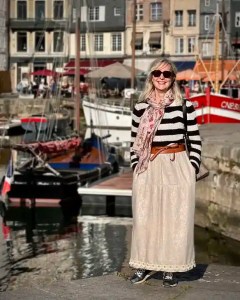
The three colourful wooden fishing boats drifting in the harbour, the ones in every photo of Collioure, are staged. They don’t fish.

The fisherman’s-house street, Rue de la Carranque, the one Derain painted, is beautifully kept. It’s now rented out as vacation cottages and unfortunately the top end of the street has a strong sewage smell.


And the view Matisse and Derain painted from is gone: the Ministry of Defence built directly on the vantage point above the fisherman’s cottages and it’s fenced. The postcard overview of Collioure isn’t fully visible anymore from where it was made.

The Artist Community Is Real
Collioure is the birthplace of Fauvism. Matisse and Derain worked here in 1905, chasing the quality of light at blue hour specifically, and the Museum of Modern Art in town holds twenty reproductions from that period. That’s what most guides tell you.
The French/Dutch artist I met at the harbour is the part they leave out, a person still making a living painting in that same tradition, twenty years in. Collioure is one of a handful of towns in France that have real working artists’ colonies.
The cinema in town plays contemporary French films, not tourist-only programming and it’s open all year round.

An art project you’ll spot around the town is Points 2 Vue: twelve gold steel frames, each one composing a specific view. Thousands of photos get taken through them daily.
At first glance it doesn’t seem that interesting, but when you stop and think about it, it’s a thoughtful piece of public art. As the artist, Marc-André 2 Figueres, says: “The frame is universal, the vision is unique.”
It’s also an Instagram machine. Both things, once again, true at the same time.

The Shape of the Town
From above, Collioure doesn’t look like one village, it’s three separate clusters. Old, colourful houses climb toward the fisherman’s cottages at the north end near the old lighthouse.
A newer group of white, terracotta-roofed houses sits west, behind the Château.
A third colourful cluster wraps the cove along the water, with more recent building up the hill behind it.

Behind all three, the mountains rise into terraced vineyards that aren’t just scenery, they’re ancient businesses. The Banyuls/Collioure AOC terraces encompass more than 6,000 kilometres of dry-stone schist walls across roughly 1,700 hectares, with a drainage system called peus de gall (rooster’s feet) dating to the Templars and built to survive violent Mediterranean storms.
Every harvest is done by hand because the terraces are too steep and narrow for machinery.

My own guess, not a sourced fact: the old village sits on the side naturally shaded from the worst afternoon heat and the newer building took the side that gets full sun, which may explain why people built where they did centuries apart.
Collioure’s Catalan Culture: What’s Actually Here
Collioure sits 26 kilometres from the Spanish border, and the Catalan identity here isn’t decorative. The flag is everywhere because the culture is still Catalan first in a lot of the ways.
This stretch of coast was Catalan and Aragonese territory long before it was French. The Château Royal at the harbour’s edge was a summer residence for the Kings of Majorca, part of the Crown of Aragon and it stayed Spanish until the Treaty of the Pyrenees handed Roussillon to France in 1659. (Places like this have looong memories!)
Locals still call the region Catalunya Nord, Northern Catalonia, a label that shows up on bumper stickers and bar chalkboards.
Street signs run bilingual, French and Catalan, and the senyera, the four red stripes on gold, hangs from balconies that have nothing to do with tourism. The sardana, Catalonia’s circle dance, still gets danced at local fêtes.

Food carries the Catalan flavour too. Collioure’s anchovies, cured and jarred by a handful of family-run houses along the harbour, are the town’s actual export, the thing chefs elsewhere in France ask for by name.
The town shares a motto with the local Catalan rugby club: Sempre endavant, mai morirem. Always forward, we will never die.
Collioure Property Prices: The Cost of Living and Real Estate Reality
Prices last verified against DVF transaction data, August 2026.

The median house price is about €472,500 for standard listings in the Collioure area, averaging between €4,300 and €5,600 per square metre. Luxury villas can run into the millions.
In town, apartment prices run about €5,000 to €8,400 per square metre. So a small 25 m² (270 ft²) apartment in town can cost you around €210,000.


A 107 m² (1,151 ft²) house with mountain views runs about €620,000. While expensive for the Pyrénées-Orientales department, Collioure remains more affordable than prime French Riviera spots.
Old-village houses and apartments are narrow, painted bright orange, yellow, or pink, with contrasting shutters and iron balconies dense with flowers.

Many of them are seasonal rentals.
You can find apartments for rent in the village centre from €1,680 to €445 a week depending on location and season.
Remember when you’re looking at listings that the French describe real estate differently than North Americans.
For the commune as a whole, not just old-town and harbourfront listings, the median lands lower: about €4,843/m² across all property types, based on 95 recorded sales in 2024 (DVF, via notaires.fr). Prices here are up roughly 22% over five years, which is the gap between that commune-wide number and the listings above.
Average Cost of Living for 1 person

Collioure is too small for Numbeo’s own index, so these ranges come from my own tracking, rent listings, grocery runs, the Wednesday market, during time on the ground in May 2026, checked against Pyrénées-Orientales departmental averages.
Comfortable Living
To live comfortably in Collioure with some room for savings, dining out and occasional leisure activities, you would typically need: €1,748 – €2,668/month including rent.
Scouting Tip
If you’re scouting and want to stay in a hotel, Hôtel-Restaurant Les Roches Brunes has a terrace over the bay and its own parking for guests.

For a longer look at the town through someone who actually paints here, a Fauvism-trail walking tour covers the same ground the museum’s reproductions do, on foot.
If you’re weighing Collioure against a full move rather than a visit, A Tasting: Find Your France Guide and Quizz, walks through your non-negotiables that are worth ranking before a town like this one gets disqualify or not.
(Kit embed: Starter Kit – Blog Inline)
The Best Villages Near Collioure If You Want a Real French Village
The following places are real modern-day French villages, which are charming in their own way, but do keep in mind they don’t carry the same charm as Collioure.
Port-Vendres, the next town south, is the direct answer to “old villages around Collioure France to live.” It’s a working, resident-populated place rather than a postcard and it’s close enough to Collioure’s to go visit easily. Port-Vendres versus Collioure is tourist-town-versus-working-town and Port-Vendres wins if regular daily life is your goal.
Alénya, on the drive in, is older than it first looks. The base construction is river-stone and split limestone, the Catalan norm, but a lot of houses carry renovated red-brick surrounds around the windows and decorative brick under the rooflines, the same red-corner detail you see in Toulouse. The 13th-century Church of Sainte-Eulalie-et-Sainte-Julie has a Catalan bell wall and there’s a brick-and-limestone mausoleum on rue des Vignes worth the detour on its own.
Banyuls-sur-Mer is where the terraced AOC vineyards above actually live, a real wine-producing town.

If you want to see the terraces up close for free, Château de Valmy has a small dirt lot past the winery (no campers) used by hikers. There you’ll find a board that lays out the hiking route. The Château also offers wine tours and has a restaurant.

Tip: If you walk up a bit further up the curved road past the château, you’ll come to a free municipal park with public washrooms. You can get a good view of the Château from there and the park has interesting art installations.

Tip: Walk the coastal trail Sentier du Littoral (Coastal Path) to get a good view of the surrounding area. I find you see so much more when you’re walking versus driving. It runs through Collioure north toward Argelès-sur-Mer and south to Cerbère, easy to miss if you’re not looking for the entry points.
The path in Collioure starts at the stadium and there is a paid parking lot there called Parking du Stade (P5). The entire trail in France is 36 km, but the piece between Argelès-sur-Mer and Collioure is only about 5 km. If you find you make it to Argelès-sur-Mer and dread the thought of walking back, remember there is the passenger boat that runs between the two.
The Verdict: Who Collioure Is Actually For

Collioure is for someone who wants a second home or a pied-à-terre built around art, light and easy Mediterranean living, not someone hunting an undiscovered village to build a full daily life in.
It’s right for the beauty-first buyer, the artist or photographer chasing the Fauvist light, the person who wants Collioure as a vacation base for the Pyrénées-Orientales corridor rather than a full-time address.
It’s right for the person who wants to build a tourist focused business.
It’s wrong for anyone who wants a real village where you’ll know your neighbours by name.
It’s wrong for anyone who wants the options and diversity of a larger city.

If you’re still deciding between a week here and a life here, French Towns Worth a Week shares some ideas for you. Most Beautiful Towns in France has Collioure on it too, if you want to check out other beautiful towns to visit in France.
If you’ve stayed in Collioure longer than a weekend, I’d like to know if you think it’s a good town for a second-home. Drop it in the comments.
Do you need to speak French or Catalan to live in Collioure?
French, yes. Daily life here runs in French, not English, market vendors and pharmacists included. Catalan is the cultural layer underneath it: you’ll hear it at the rugby club and see it on signage, but you don’t need to speak it to get by.
Is there an airport near Collioure?
Perpignan-Rivesaltes is the closest, about 30 minutes away, with limited routes. Barcelona-El Prat, roughly two hours south, has international connections.
What’s the best time of year to see the real Collioure, not just the postcard version?
Go in the off-season, not August. The wooden boats are still staged year-round, but the crowds thin out enough that you can tell which shopfronts are open for locals and which ones only unlock for July. April/May and Oct/Nov are good choices.
Is Collioure worth an overnight stay, or is it really a day trip from somewhere else?
Stay at least one night. The town changes after the day-trip buses leave; the harbour empties, the light at blue hour is the whole reason painters came here and you won’t see either one if you’re heading back to Perpignan for dinner.


Leave a Reply