Table of Contents
A Grey Day by the Sea
While staying in Fécamp, we took a day trip to explore the nearby coastal villages of Étretat and Yport—two postcard-worthy towns perched on the edge of Normandy’s famous white cliffs. It was a grey day in late October, and the overcast sky only added to the drama of the landscape. As we drove through the countryside, we noticed how flat the land remained right up until about a kilometre from the coast. Then suddenly, the landscape shifted – the ocean began to influence the air, you could smell the salt and the roads started to angle down.
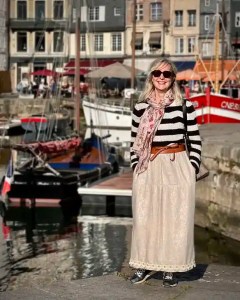
We stopped in Yport first. There were only a handful of other tourists around – just the way we like it. Quiet streets, nearly empty cafés and space to take it all in without the buzz of summer crowds. I could imagine that in warmer months, these towns would be humming with life.
In fact the Normandy Tourism Board recommends you visit in the shoulder seasons as it gets SO busy during the summer. I can’t even imagine trying to drive on the little streets during peak season, let alone find parking!
We wandered the tiny streets for a few hours and then hopped back into the trusted Mini and drove on to Étretat.
In the Footsteps of Monet
Étretat has long inspired artists, most famously Claude Monet, who painted its dramatic rock formations many times. Standing on the beach, with the stony beach making up the shore and the iconic stone arch, the Porte d’Aval, rising in the background, it’s striking how little has changed. The scene that captured Monet’s imagination still exists in almost exactly the same form – it’s like stepping into one of his paintings.


The architecture in both Étretat and Yport is distinctly Norman, with half-timbered buildings, grey slate roofs, and colourful shutters. The towns are petite and picturesque, brimming with charm and coastal character. Whether it’s the small harbour in Yport or the elegant villas dotting the cliffs in Étretat, the details of each place tell a story of seaside life from its fishing roots in Roman times to luxury seaside living. As early as 1840, visitors from Paris and England flocked to Etretat.
Hiking to the Hidden View
The highlight of our coastal visit came when we decided to view the Porte d’Aval from the other side, a less common perspective that requires a bit of effort. While many choose to hike the cliffs from Étretat itself, we opted for a different route. We drove to the trailhead at the Valleuse d’Antifer, a narrow natural valley that cuts down to the sea.
From there, we took a 2km walk through a quiet path, descending to the beach and cliffs below. The moment the trail opened up to the vast ocean view, I felt a rush of quiet joy. The beach stretched out before us and we began walking eastward toward Étretat, the sound of waves rolling on the rocky shore guiding us.
The most magical moment came as we passed through what looked like a man-made cave with openings at both ends, a tunnel carved right through the cliff. Emerging on the other side, we were met with a breathtaking, close-up view of the Porte d’Aval, standing tall and majestic as the wind whipped around us.
It was the highlight of our stay in the region. The wind tangled my hair, the sea roared at our feet, and I felt completely immersed in the moment, a heady mix of awe, freedom, and a touch of adventure. That sense of discovery, of finding a path less travelled and being rewarded with a stunning view, is what makes travel so exhilarating.


Got thoughts, questions, or just want to say hi? Leave a comment below and let’s chat!